
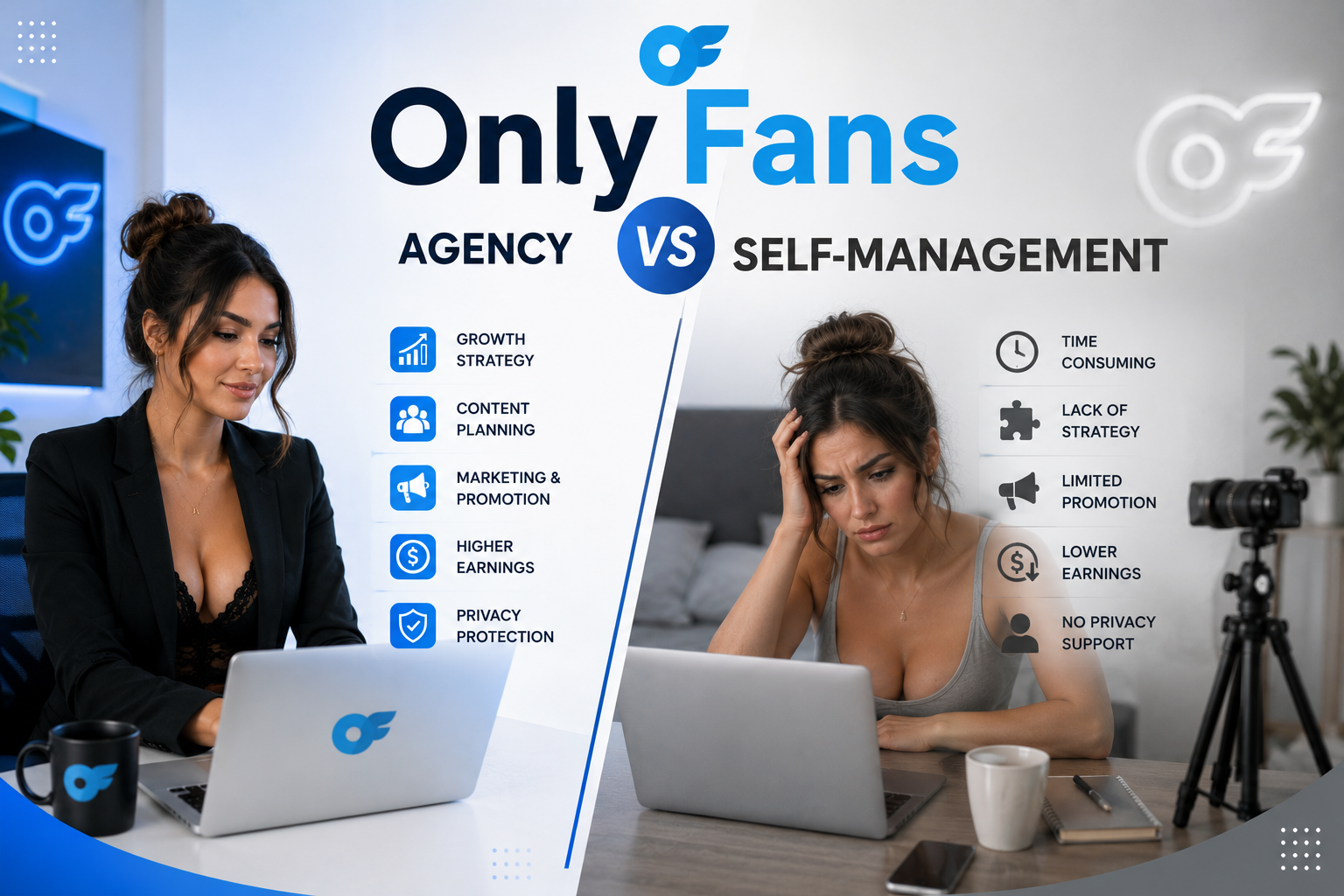
What is the core difference between an OnlyFans agency and self-management?
The primary difference between an OnlyFans agency and self-management lies in the division of labor: an agency provides a team of specialists to handle marketing, chat, and account logistics in exchange for a percentage of revenue, while self-management requires the creator to act as their own CEO, marketer, editor, and customer service representative. When you manage your own account, you retain 100% of your earnings but assume 100% of the operational burden. When you hire an OnlyFans management agency, you trade a portion of your gross revenue for the infrastructure, experience, and time-saving systems necessary to scale a brand beyond what a single person can handle manually.
For many creators, the transition from hobbyist to professional marks the exact moment they realize that "doing it all" is a barrier to further growth. You are essentially deciding between being a solopreneur who controls every pixel of their brand, or a media personality who partners with experts to maximize the reach and monetization of that brand. Both paths are viable, but they serve different stages of a creator's career trajectory.
Key Takeaways
- Self-management offers full control and 100% revenue retention but carries a high risk of creator burnout and plateauing growth.
- An OnlyFans agency provides specialized labor, such as 24/7 chatting and advanced marketing, to help scale revenue beyond individual capacity.
- Choosing between the two depends on your current monthly revenue, your desire to handle administrative tasks, and your long-term goals for your brand.
- A professional management agency like OnlyX Agency can provide the structural support needed to transition from a side hustle to a full-scale business.
How does the revenue model compare?
The financial math is the first thing every creator considers. In a self-managed scenario, the platform takes its 20% cut, and you keep the rest. It is simple, transparent, and maximizes your take-home pay on every dollar earned. However, this calculation ignores the "hidden" costs of self-management: the hours spent replying to messages, the time spent researching trends, and the lack of specialized marketing knowledge that often leads to "money left on the table."
When you partner with an agency, you enter into a revenue-share agreement. Typically, this ranges from 30% to 50% of your gross earnings, depending on the scope of services provided. While this sounds like a significant reduction, the goal of a reputable agency is to increase your gross revenue so substantially that your net profit—the actual cash in your pocket—is higher than it would have been if you were working alone. If you are making $5,000 a month on your own, and an agency helps you scale that to $20,000 a month, you are coming out ahead even after the agency takes their cut.
The hidden costs of self-management
When you manage your own account, you are paying for your time with your own life. If you spend six hours a day chatting to increase conversion rates, that is six hours you aren't spending on content creation, mental health, or personal growth. Furthermore, most independent creators struggle to implement advanced marketing tactics like funnel optimization, cross-platform traffic redirection, and sophisticated email marketing. These are not just "nice-to-haves"; they are the pillars of a seven-figure business. When you account for the opportunity cost of your time, self-management is often more expensive than the agency fee.
Pros and Cons: Agency vs. Self-Management
| Feature | Self-Management | OnlyFans Agency |
|---|---|---|
| Revenue Retention | 80% (after OF cut) | Usually 50%-70% (after OF cut) |
| Time Commitment | High (Full-time+) | Low (Focus on content) |
| Control | Total (100%) | Collaborative |
| Growth Potential | Limited by your time | High (Scalable) |
| Administrative Burden | High (Chat, Support, Marketing) | Minimal (Managed by team) |
What does an OnlyFans agency actually do for you?
A high-quality management agency doesn't just "post photos." They function as a full-service digital marketing firm. Their primary focus is usually on the three pillars of account growth: acquisition, conversion, and retention.
1. Acquisition and Traffic Management
Acquiring new subscribers is the hardest part of the business. An agency usually has dedicated teams that understand how to navigate the complex landscape of social media algorithms. They know how to optimize content for platforms like Instagram, TikTok, and X (formerly Twitter) to drive high-intent traffic to your OF page. They handle the account bans, the shadowbans, and the constant pivoting required when platform guidelines change.
2. High-Converting Chatting
Chatting is where the real money is made. It is not just about saying "hi"; it is about building a connection, managing a CRM (Customer Relationship Management) system, and knowing exactly when to upsell a PPV (Pay-Per-View) message. Professional agencies hire chatters who work in shifts to ensure your account is active 24/7. They use data to track which hooks work for which types of subscribers, ensuring that you don't miss out on sales while you are sleeping or taking a day off.
3. Account Audits and Optimization
Most creators have "leaks" in their funnel. Maybe your bio isn't optimized, or your pricing structure is confusing, or your PPV strategy is too aggressive for your specific audience. An agency performs regular audits to fix these leaks. At OnlyX Agency, we look at the data points—the conversion rates, the average revenue per user, and the churn rate—to make evidence-based decisions rather than guessing what might work.
Why do creators reach a plateau on their own?
The "Creator Plateau" is a well-documented phenomenon. You start, you see some success, you work harder, you see more success—and then you hit a wall. Usually, this wall is hit at the $5,000 to $10,000 monthly mark. This is the limit of what one person can handle while maintaining high-quality content production and high-quality fan interaction.
If you are the one filming, editing, posting, chatting, and marketing, you are essentially working five jobs. Eventually, something has to give. Most creators, when they reach this point, start to sacrifice the quality of their interactions or the frequency of their content. This leads to a decline in subscriber satisfaction, which leads to higher churn rates. An agency solves this by removing the operational "noise," allowing you to focus on the one thing that only you can do: being the face and the creative force of your brand.
Expert Insight: The most successful creators don't try to be experts at everything. They realize that their time is best spent on high-leverage activities—like shooting high-quality content or building a personal connection—and they delegate the low-leverage, repetitive tasks to a team. If you are spending 4 hours a day on basic administrative tasks, you are losing money, regardless of how much you think you are "saving" by not hiring an agency.
How to vet an OnlyFans agency
Not every agency is created equal. Because the industry has seen a massive influx of new management firms, you need to be cautious about who you hand your login credentials to. Here are the red flags to watch for:
- Lack of Transparency: If they won't show you how they track revenue or if they are vague about their reporting, walk away.
- Guaranteed Results: No one can guarantee a specific income figure. Anyone promising "$50,000 in your first month" is likely using black-hat tactics that will get your account banned.
- Poor Communication: If they don't answer your questions clearly or seem disorganized during the onboarding phase, they will be even worse when managing your actual money.
- Ownership Issues: Ensure that you retain ownership of your account and your content. A legitimate agency should act as a partner, not an owner.
When you speak to a team like OnlyX Agency, look for a focus on long-term brand building. We prioritize sustainable growth and compliance with OnlyFans' policies over "get rich quick" schemes that put your account at risk.
Is it time for you to hire an agency?
You probably don't need an agency if you are just starting out. In the beginning, you need to understand the fundamentals of your own brand. You need to know who your fans are, what they like, and how your content performs. If you hire an agency too early, you might not have the brand identity established enough for them to effectively market you.
However, you should consider hiring an agency if:
- You are consistently making $5,000+ per month but feel like you cannot possibly do more.
- You find yourself feeling burned out, irritable, or unable to enjoy your life outside of the screen.
- You have a backlog of content that you never get around to posting or promoting properly.
- You want to scale your revenue to the six-figure mark but don't know how to build the infrastructure to support that kind of traffic.
What happens after you sign with an agency?
The onboarding process with a professional agency should be structured and methodical. First, they will conduct a deep-dive audit of your current account. They will review your content library, your historical sales data, and your existing fan interactions. This is where they identify the "quick wins"—the simple changes that can increase your revenue almost immediately.
Next, they will align on a content strategy. This doesn't mean they take over your creative vision; it means they help you organize your content schedule to ensure you are posting when your audience is most active. They will set up systems for PPV messaging, ensuring that your fans are receiving the right offers at the right time. Finally, they will begin the active management phase, where they take over the day-to-day operations like messaging and traffic generation.
The psychological shift of professional management
One aspect often overlooked is the psychological relief that comes with having a team. When you are self-managed, the pressure of "always-on" availability is constant. You are worried about every message, every dip in traffic, and every notification. This creates a state of perpetual anxiety that is detrimental to your creativity. When you work with a team, you can actually take a day off. You can go on vacation without the fear that your income will drop to zero. This peace of mind is often worth more than the revenue share itself.
Common pitfalls in the agency-creator relationship
Even with a good agency, things can go wrong if expectations aren't managed. The most common pitfall is a lack of communication regarding the creator's comfort level. If an agency suggests a marketing angle or a type of content that makes you feel uncomfortable, you must speak up immediately. A good agency will respect your boundaries and pivot. If they don't, that is a sign of a poor partnership.
Another pitfall is the "set it and forget it" mentality. Even with an agency, you are still the CEO of your business. You should have weekly or bi-weekly check-ins to review performance and discuss strategy. If you aren't involved in the direction of your brand, you will eventually become a commodity, which is the opposite of what you want to achieve.
How to protect your brand identity
Your brand is your most valuable asset. When working with an agency, ensure that your "voice" remains authentic. Whether you are chatting with fans or posting on social media, the content should still feel like it comes from you. Reputable agencies will study your personality and your brand's unique "vibe" to ensure that their communications sound like you. If you notice that your interactions are becoming robotic or "spammy," address it immediately. Your fans are paying for a connection with you, not a connection with a generic chat script.
The importance of long-term scalability
Self-management is often a sprint; agency management is a marathon. When you hire an agency, you are building a system that can withstand growth. If you go viral, can your account handle the influx of messages and sales? If you are self-managed, the answer is usually no. You will get overwhelmed, the quality of service will drop, and you will lose the very fans who helped you go viral. An agency provides the "buffer" that allows you to handle massive spikes in traffic without breaking your business model.
How OnlyX Agency approaches the partnership
At OnlyX Agency, we view our role as an extension of your own business. We don't believe in a one-size-fits-all strategy. We look at your specific strengths—whether that’s your personality, your niche, or your content style—and we build a growth plan that amplifies those strengths. We handle the technical side, the data analysis, and the heavy lifting of customer service, while you focus on the creative work that made your fans follow you in the first place.
Our goal is always to create a sustainable, long-term business that allows you to reach your financial goals without sacrificing your mental health or your creative integrity. We provide the tools, the team, and the expertise; you provide the vision and the content. It’s a partnership built on transparency, clear communication, and a shared commitment to growth.
Why the "Self-Managed" ego trap is dangerous
There is a pervasive belief among creators that "no one can do it as well as I can." While it is true that no one will care about your brand as much as you do, it is also true that you are not a master of every single discipline required to run a seven-figure business. You may be a great creator, but are you a great data analyst? Are you a great CRM manager? Are you a great SEO strategist? By holding onto every task, you are actually limiting your own potential. The most successful people in any industry are those who know how to delegate effectively. Recognizing that you need help is not a sign of weakness; it is a sign of business maturity.
Final thoughts on scaling your business
The choice between self-management and hiring an agency is ultimately a choice about what you want your future to look like. Do you want to be a solopreneur who works 80 hours a week to keep your income at a steady level, or do you want to be a brand owner who leads a team to achieve exponential growth? There is no "right" answer, only the answer that aligns with your current capacity and your long-term ambitions. If you feel that you have hit a ceiling, or if the daily grind is preventing you from creating the content you truly want to make, it is time to look at the professional support that an agency can provide. Taking that step from "doing it all" to "managing the vision" is the single most important transition you will make in your career.
Frequently Asked Questions
How do I know if I'm ready for an OnlyFans agency?
You are likely ready for an agency if you are consistently hitting a revenue ceiling, feeling overwhelmed by daily tasks like chatting and marketing, or if you find that you have no time left to create high-quality content. If you are already at a point where your account is generating enough revenue to justify a split, and you feel that your time is better spent on high-level strategy rather than day-to-day operations, it’s time to start interviewing agencies.
Will I lose control of my account if I hire an agency?
A reputable agency should never take full control away from you. You should always have access to your account, the ability to see all communications, and final say over the direction of your brand. You are the business owner; the agency is your service provider. If an agency insists on "full control" without transparency, that is a major red flag.
How does an agency protect my privacy?
Professional agencies prioritize creator safety and privacy. They use secure systems to manage your account, limit access to sensitive information, and operate under strict confidentiality agreements. They are also experienced in managing the risks associated with the industry, such as handling leaks and protecting your personal data, which is often a challenge for creators working on their own.
Can I still create my own content if I have an agency?
Absolutely. In fact, most agencies prefer it. You are the face and the creative force of your brand. The agency's role is to handle the marketing, the distribution, and the monetization of that content. You should always be the one driving the creative direction, while the agency provides the infrastructure to ensure that content reaches the widest possible audience and generates the maximum amount of revenue.
How long does it take to see results after hiring an agency?
It depends on the state of your account when you start. If your account is already established, you might see improvements in conversion rates and revenue within the first few weeks as the agency optimizes your funnel and chat strategy. If you are starting from scratch or have a very small following, it may take longer to build the necessary traffic and trust. A good agency will provide you with a clear roadmap and realistic expectations based on your specific situation.
Get a Free Strategy Call
Whether you're just starting out or already earning — we'll audit your OnlyFans account, spot your biggest revenue gaps, and show you exactly what to do next. Free, no commitment.
We respect your privacy. No spam, ever.